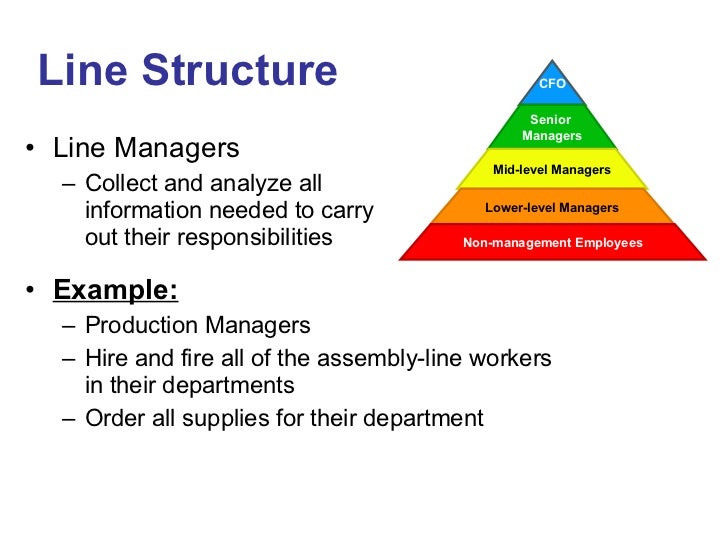
The level of management determines a chain of command, the amount of authority & status enjoyed by any managerial position. Line authority “refers to those positions and elements of the organisation which have responsibility and authority and accountable for accomplishment of primary objectives.” dalton mcfarland has defined line authority as “the basic authority in an organisation, is the ultimate authority to command act, decide, approve or disapprove.
Ian's A/S Business Blog Key Elements of Organisational Structure
Responsibility is the obligation of a subordinate to perform a duty, which has been assigned to him by his superior.
Levels of authority in an organization. Levels of management that make up organizational authority include operation level, middle level and top level management. In a managerial hierarchy, each organizational unit is controlled and supervised by a manager in a higher unit. This level of management consists of an organization’s board of directors and the chief executive or managing director.
It is a useful tool to figure out an organization's. A traditional organisation is generally split into three levels: Authority and responsibility flow from top to bottom.
In this article, jurgen appelo, author of management 3.0: The higher a manager, the more power they have. It consists of the board of directors, chief executive officer (or the managing director), general manager.
According to mooney and reiley “authority is the principle at the root of organization and so important it is that it is impossible to conceive of an organization at all, unless some person or persons are in a position to. Authority means a formal, institutional or legal power in a particular job, function or position that empowers the holder of that job, function or position to successfully perform his task. It is the highest level in the hierarchy of authority.
There are different levels of authority in an organisational structure from the top executive to the worker. The next time you want time to think or to try for further concessions, tell the other party that you have to discuss the matter with one or more of the following people in your organization: Generally, the management structure has three levels:
Each of us has encountered such limits and accepted them without much resistance. Each level is typically associated with a salary range and a series of job titles. An organizational chart is a diagram of an organization's structure.
The assurance with which you handle your work—not just the number of team members you have or the size of your budget—influences your degree of authority. The person with the most formal authority is at the top of the hierarchy. Members of the organizational authority include line, staff and functional authority.
Administrative, managerial, or top level of management. Organizational constraints to authority are common. Upper, middle, and lower levels.
Authority is the basis of organization in as much as an organization is described as system of authority relationships. The term “levels of management’ refers to a line of demarcation between various managerial positions in an organization.the number of levels in management increases when the size of the business and work force increases and vice versa. Executive management, middle management, management, advisors and employees.the following is a common structure for job levels.
Organizational authority refers to the hierarchy in a company from top level management to entry level employees. The authority matrix more specifically, an authority matrix tries to solve two of the more problematic issues in human resources: The scalar principle maintains that these levels represent gradation of distributed authority, each successive level downward representing a decreasing amount of authority, a decreasing scope of authority and often a.
The number of levels of management in an organisation depends on the size, the nature of work, the technology used and some other factors of the organisation. Role clarification in today’s changing work environment; It is the ultimate source of power and authority, since it oversees the goals, policies, and procedures of a company.
Jobs levels can be grouped into five areas: Top performers are given the most respect in an organization. 1/top level / administrative level.
Managers at all these levels perform different functions. Here is how it works. The authority and level of responsibility of the managers in each of these levels reduce as we move down the ladder.
Job levels are categories of authority in an organization. It will show the job titles and patterns of authority in the organization. Here are five factors that determine how much authority you really hold over others:
Top, middle, and supervisory management.
Decision Making Authority Job Description. The outcome of these presentations to the decision authority is the acceptance of operational risks by a properly informed decision authority. Make faster decisions with delegated authority.
Effective Delegation Understanding Responsibility, Authority, and from www.journalofnursingregulation.com
Fukuyama (1995, cited in gur and bøjrnskov, 2016, p.2) summarizes this issue as follows: Facilitating a brainstorming session to generate possible names for a new product. You make decisions based on recommendations from your team, where it’s your job to have.