Forming Norming Storming Performing Model Of Team Development. During the norming stage of team development, team members begin to resolve the discrepancy they felt between their individual expectations and the reality of the team's experience. Coined by psychologist bruce tuckman in his 1965 article developmental sequence in small groups, the forming, storming, norming and performing model of group development explains how groups form and what happens in each stage of group development.
tuckman's team development model Google Search Team development from www.pinterest.co.kr
Forming, storming, norming, performing and adjourning. The idea originated in 1965 with american. Each of these words represent one stage in the model, which individuals inevitably must go through as they form a group into a team.
According to bruce tuckman, team development has five stages: Forming, storming, norming, and performing in groups bruce w.
Use Tuckman's Model of Team Dynamics (Forming, Storming, Norming
The forming, storming, norming, performing model was created by tuckman and it is a concept that is used by many six sigma professionals across the world.
Norming storming performing model. The most common is that teams go through a series of different levels before effectiveness is achieved. In 1977, tuckman, jointly with mary ann jensen, added a fifth stage to the four stages: Team members behave differently in each stage, and the project manager must act accordingly to help them develop.
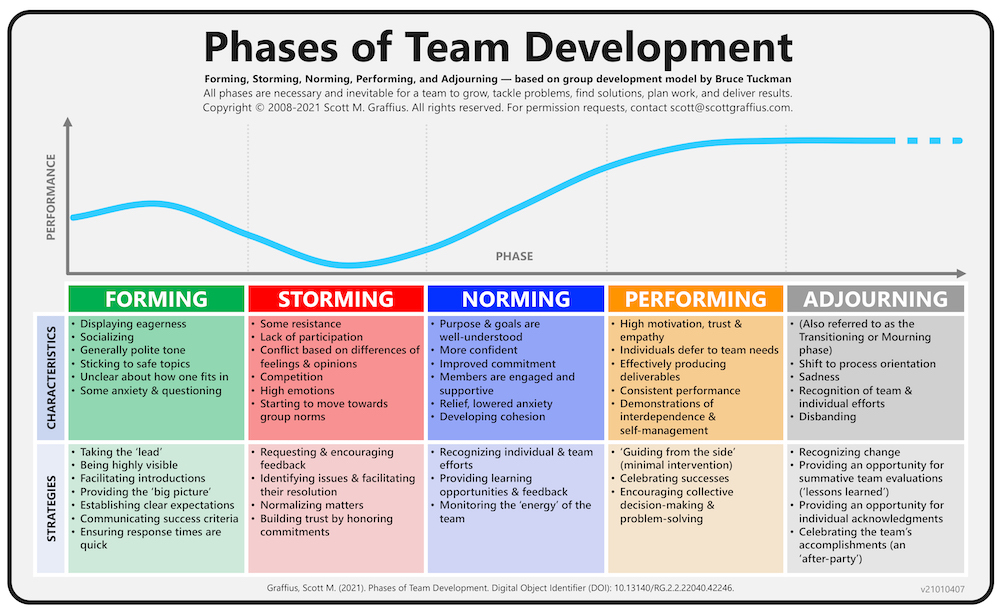
Forming stage of group development. This model is known as the forming, storming, norming, and performing model (fsnp). Let’s now see what typically happens in each phase of the model.
In a 1965 article in the psychological bulletin, bruce tuckman introduced a team and group development model that maps a team’s. About the model psychologist bruce tuckman first came up with the memorable phrase forming, storming, norming, and performing in his 1965 article, developmental sequence in small groups. he used it to describe the path that most teams follow on. The forming, storming, norming, and performing model describes these stages.
Introducing tuckman's model psychologist bruce tuckman first came up with the memorable phrase, “forming, storming, norming, and performing” in 1965. In 1965, bruce tuckman identified four stages of development — forming, storming, norming and performing — that every team experiences. The concept of forming, storming, norming and performing (fsnp) describes the four stages of psychological development a team goes through as they work on a project.
The purpose of this phase is to create a team with clear structure, goals, direction. Teams move through each stage as they overcome challenges, learn to work together and eventually focus on accomplishing a shared goal. Dr bruce tuckman published his 'forming, storming, norming, performing' model in 1965.
He later added a fifth stage, adjourning, in the 1970s. Psychologist researcher bruce tuckman formed tuckman's model as part of his 1965 paper developmental sequence in small groups. In tuckman’s early professional career, he worked with a small group of social psychologists at the naval.
In the first phase, forming, teams are uncertain about the team goals and how to work together.in the second phase, storming, teams challenge boundaries and get to know each other and how to work together.in the norming phase, teams. Let’s discuss the stages of team formation and the role of the project manager. Much like individuals grow and develop over time, so does a team.
The idea originated in 1965 with american. In a short article titled “development sequence in small groups,” he introduced the concept of forming, storming, norming and performing as stages in team development leading to enhanced effectiveness and functioning. Similarities can be seen with other models, such as tannenbaum and schmidt.
Forming, storming, norming, performing, and adjourning. Each of the 4 steps plays a massive role in team development. 1.the tuckman model, 2.the standard team model, 3.moore's team framework, 4.the siebert model
We consider his contribution and the model's continuing use. By understanding it, you can help your team to become productive more quickly. These are known as tuckman stages.
The tuckman model describes the phases that groups of individuals go through when they first begin working together as a team. This mindtools talk explains psychologist bruce tuckman's forming, storming, norming, and performing model that gives you a great way to understand team dy. The 'forming, storming, norming, performing' theory is an elegant and helpful explanation of team development and behaviour.
The us navy tasked him, along with a group of other social psychologists, with analysing the dynamics of forming a team, and how the leadership style changes as the group develops. While many would label it as overly. They use it to predict as well as explain how their team is performing.
The first of tuckman’s stages of team development is the forming stage. In 1965, bruce tuckman produced one of the most quoted models of team development. Tuckman produced one of the most quoted models of group development in the 1960s.
Program managers, team leaders, and project managers should understand the model to enable them to better lead the team and adapt their behaviors appropriately to each stage in order to give the.