But in fact the consciousness has not. That is when for many of us our journey into dying begins to become more apparent.
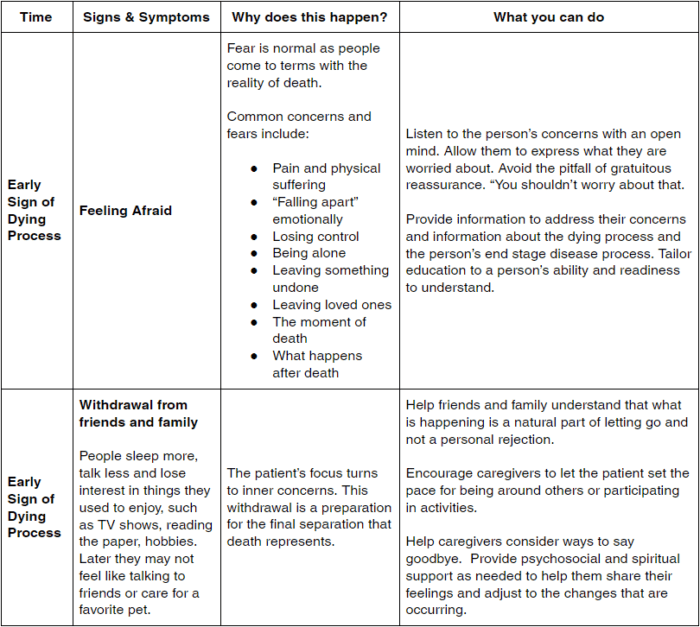
Stages of the Dying Process Table 3
Where treating acute and chronic illness usually involves finding a tolerable path to eliminating or preventing the progression of a condition, treating terminal.
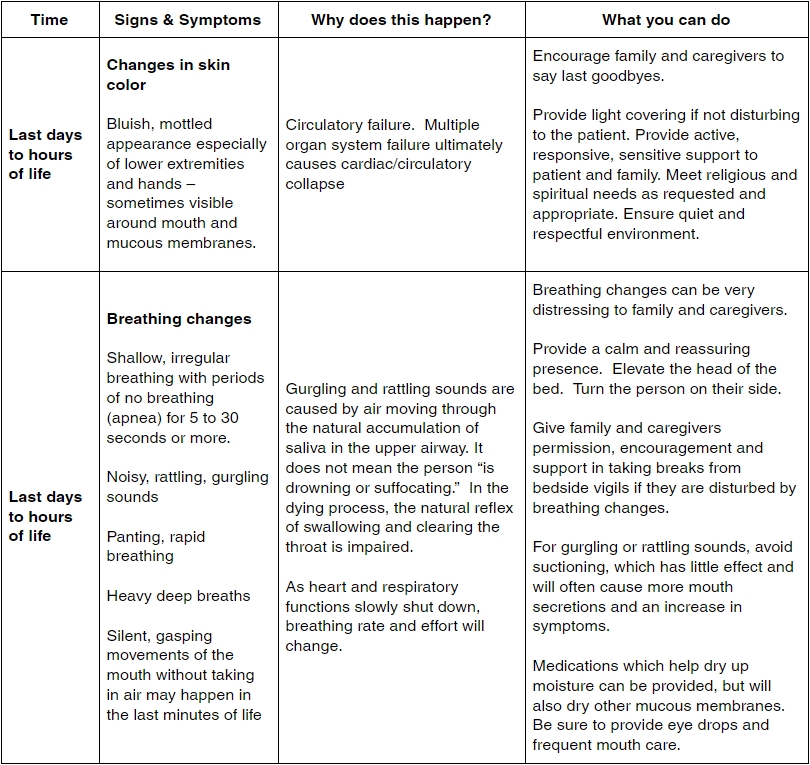
Stages of death & dying. A person will start to detach from social activities and spend more time sleeping. The person receives news that he is dying, and either does not take it seriously or tries to escape from the reality of the situation. This article looks at these steps in the journey of dying.
Any pain that the dying person feels at this point can usually be managed by a doctor in some way, but it can be unbelievably difficult to watch these final steps of a person's life. Describe the five stages of grief and provide examples of how a person might react in each stage. He might say something like, “cancer could never happen to me.
People dying may precede the survivors in this state, which typically. At this stage it is as if the dying person has no memory. Upon learning of their own impending death, dying people's first reaction is often denial, in which they refuse to acknowledge the.
When someone is dying, their heartbeat and blood circulation slow down. Caretakers at hospice care in los angeles tell us that there are three main stages of dying: The active stage of dying has two phases.
Longer periods of sleep occur more often. In the days before death, people often begin to lose control of their breathing. In the context of death and dying, patients, their loved ones, and the health care team must shift their goals.
The skin tightens and a grayish pallor sets in Begin separating from daily routines. The five steps are denial, anger, bargaining, depression, and acceptance.
Since there is no physical movement, no heartbeat, and no movement in the channels, some people think that this is the end of dying; Start to show lack of interest in the television, newspapers and everyday life. Her late 1960s book, on death and dying, described five distinct stages most people will undergo when facing a terminal diagnosis.
Medical professionals in all disciplines work with dying patients, and doing so effectively is difficult. People at hospice care in burbank, ca, gauge these stages in different changes in responsiveness and functioning. The first stage is denial.
It begins with what happens about one to three months before death, then during the last two weeks before death, and then the last few days of life. Not interested in visiting with company or talking on the phone. When we have experienced the distant signs of death, the close signs of death will occur.
The stage right before a person dies is called the agonal phase. In this last stage, individuals embrace mortality or inevitable future, or that of a loved one, or other tragic event. Where treating acute and chronic illness usually involves finding a tolerable path to eliminating or preventing the progression of a condition, treating terminal illness must involve preparing for death as well as efforts to mitigate.
Feel more like withdrawing into our inner realms. For many people, the dying process comes into view at about a month to three months before death. The dying person is often disoriented, and it will seem like he or she can't get comfortable.
These can be categorized into the stages at the exact moment of death and the stages that occur some moments after death. The stages of dying and death. This book is about these 5 stages of dying and how their relation to the grieving process that different stages or periods of grieving are categorized.
The brain and organs receive less oxygen than they need and so work less well. Some of us start feeling less active. The stages of grief are commonly referred to as the 5 stages of dying, as referred to in her book on death and dying.
(even adults can have difficulty understanding “forever,” or that a loved one is “gone” when they die.) they need help to understand why someone has died, and that “death” means the body stops working. Perhaps the best‐known pioneer in thanatology is elisabeth kubler‐ross, who after interviewing 200 terminally ill people proposed five stages of coming to terms with death. What are the 3 main stages of dying?
The early stage, the middle stage, and the last stage. Besides the final stages of death, physicians advise hospice care upon diagnosing a terminal disease where patients are given less than six months. Some of the stages of dying start to be discernible a few months to a month before death occurs.
One to three months prior to death. In the context of death and dying, patients, their loved ones, and the health care team must shift their goals. The stages of death usually refer to various stages a dying person undergoes when preparing for death, given adequate time to prepare.
The physical stages are experienced solely by the person who is dying.