According to professor ouchi, theory z. Discussion ouchi's theory z is often referred to as the 'japanese' management style.
Chap010
Ouchi after american companies began losing ground to japanese competitors in the 1970s and 80s.

William ouchi's theory z. Theory z stresses the need to help workers become generalists, rather than specialists. According to ouchi, theory z management tends to promote stable employment, high productivity, and high e… Theory z is an integrated model of motivation.
One of our most popular videos is the one about douglas mcgregor’s theory x and theory y. Theory z of ouchi is dr. It’s interesting that ouchi chose to name his model ‘theory z’, which.
Theory z is often referred to as the ‘japanese’ management style. Another theory which has emerged, and deals with the way in which workers are perceived by managers, as well as how managers are perceived by workers, is william ouchi's theory z. Theory z was first identified as a unique management approach by william ouchi.
Barney “why ‘theory z’?” this was the question that the consequences. Executive overview this article describes the theory z proposed by william ouchi in his book published in 1981, “theory z: How american business can meet the japanese challenge jay b.
William ouchi developed mcgregor’s work. In 1981, william ouchi came up with a method that would combine american and japanese managing practice together to form theory z. It was developed by american management consultant william g.
How american business can meet the japanese challenge.” the author explains. It was introduced in the 1980s as a japanese consensus style. Genesis of ouchi's theory z.
The average person dislikes work and will avoid it. It indicated that western organizations could learn from their japanese counterparts. (ouchi, 2003) this paper discusses william ouchi''s theory z.
The z theory by william ouchi it is a theory created by this american economist and professor of management, as a continuation of theory x and theory y of douglas mcgregor. This article presents a commentary on william ouchi's book “theory z: Letter ‘z’ does not stand for anything;
It was proposed by a management scholar, william ouchi who put forwarded a theory filled with japanese elements but which also expounded. American professor and author, william ouchi developed theory z after a comparative study of american and japanese management practices popularized during the asian economic boom in the 1980s. William ouchi developed theory z after making a comparative study of japanese and american management practices.
Theory z is a name applied to three distinct psychological theories. The third was developed by w. A type z organisation has three major features.
This is the participative model. It provides a complete transformation of motivational aspect of employees which other theories are not able to emphasize. William ouchi’s 1981 theory z assumes.
Often referred to as the japanese management style, theory z offers the notion of a hybrid management style which is a combination of a. The benefits of theory z, ouchi claimed, would be reduced employee turnover, increased commitment, improved morale and job satisfaction, and drastic increases in productivity. One was developed by abraham h.
Theory z is a management philosophy that deals with organizational culture, quality that shows how employees view their management their set of beliefs, values and principles. Maslow in his paper theory z and the other is dr. He visited japan and studied their success with team and participative.
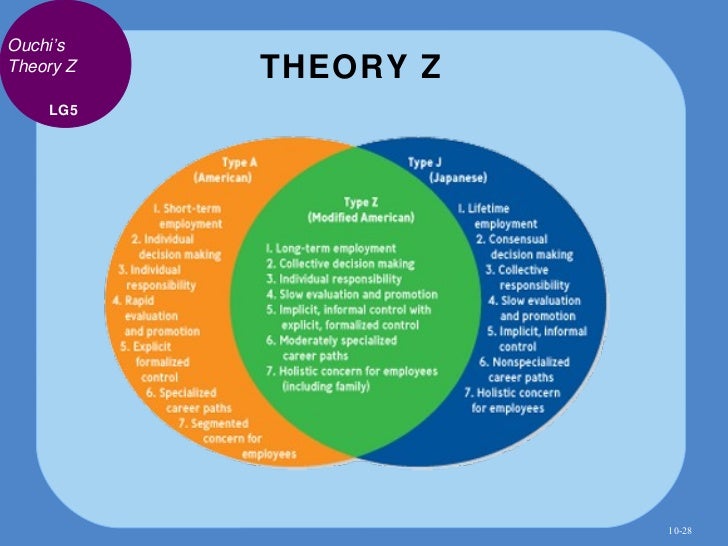
Ouchi contrasted american types of organizations (type a) that were rooted in the united states' tradition of individualism with japanese organizations (type j) that drew upon the japanese heritage of collectivism. It views job rotations and continual training as a means of increasing employees. In theory z, the relationship goes beyond the worker—family needs are recognized too.
Which is an attempt to comine the best features of japanese and american styles of management. The workers reciprocate by being totally involved with the company over a long period of time. Ouchi's theory z advocates a combination of the best of theory y and modern japanese management, placing a large amount of freedom and trust with workers, and assumes that workers have a strong.
As a result, people have asked me about theory z.theory z, which wa. ‘i like to work, it’s part of my life, i want to do well, and i will work hard if given the responsibility and recognition i deserve.’ so my boss will give me the responsibility i earn and reward me with the recognition i deserve. Ouchi was born and educated in america, but was of japanese descent.
It denotes the state of affairs found in an organization of. It describes the major postulates of japanese management practices and how these practices can be adopted to the environment of united states and other countries. Theory z suggests that large complex organisations are human systems and their effectiveness depends on the quality of humanism used.
Theory z was developed by william ouchi in 1981. William ouchi is professor of management at ucla, los angeles. William ouchi made a comparative study of the japanese and the american management practices and put forward a theory, called ‘theory ‘z’;
Theory z combines the benefits of american individualist. History theory z. can be traced to the work of douglas mcgregor in the 1950s and 1960s. Ouchi also came up with his three approaches to control in an organization's management:
Theory x ('authoritarian management' style) features: Theory z is a management approach combining japanese and american management philosophies and organization values.