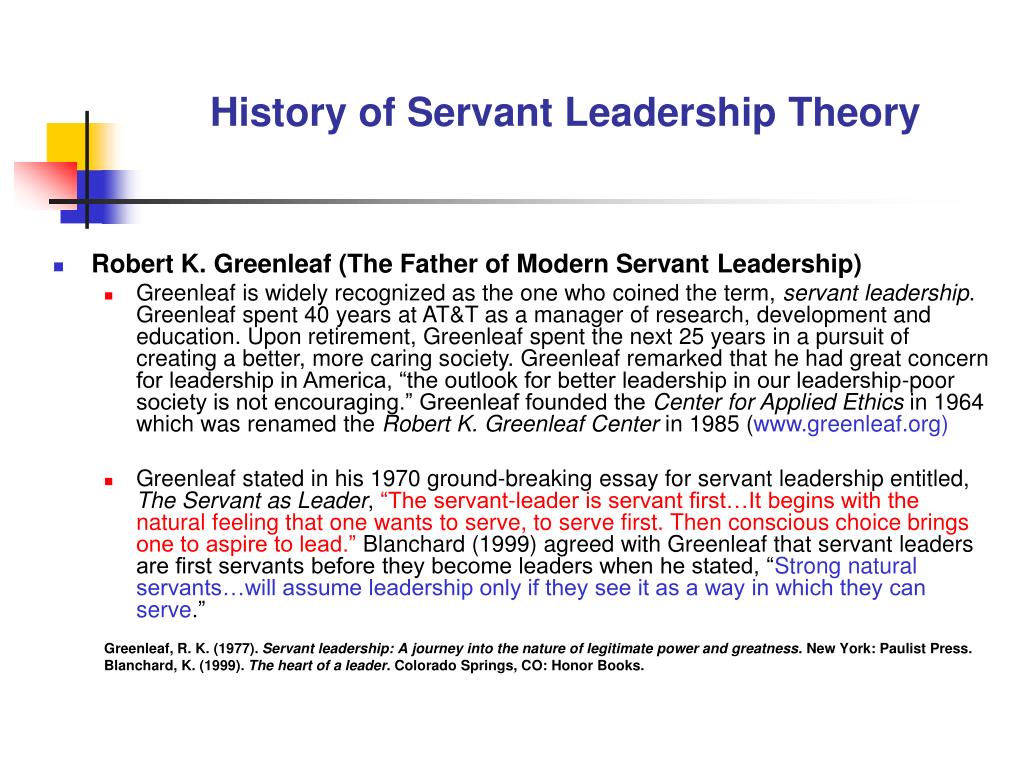
Greenleaf was the first person to articulate servant leadership theory. Servant leadership, which is a paradigm of leadership based on the philosophy of greenleaf (1977), calls for leaders to be of service to others (e.g., employees, customers, and communities).
/msl-SERVANT-acronym-2018-web-df4527f8ec304846a725eb3bad4ecc49.jpg)
What Is Servant Leadership?
Development consists of eight steps:

The servant leadership theory. The re are 7 construct of servant leadership by patterson and. Servant leadership theory development 3.1 characteristic and model of servant leadership since the concept of servant leadership was introduced by robert greenleaf in 1977, there were some development on its concept – even though robert greenleaf not suggested the model or characteristic of servant leadership itself. Servant leadership focuses on the role of the leaders as serving the needs of others through employee development and goal attainment.
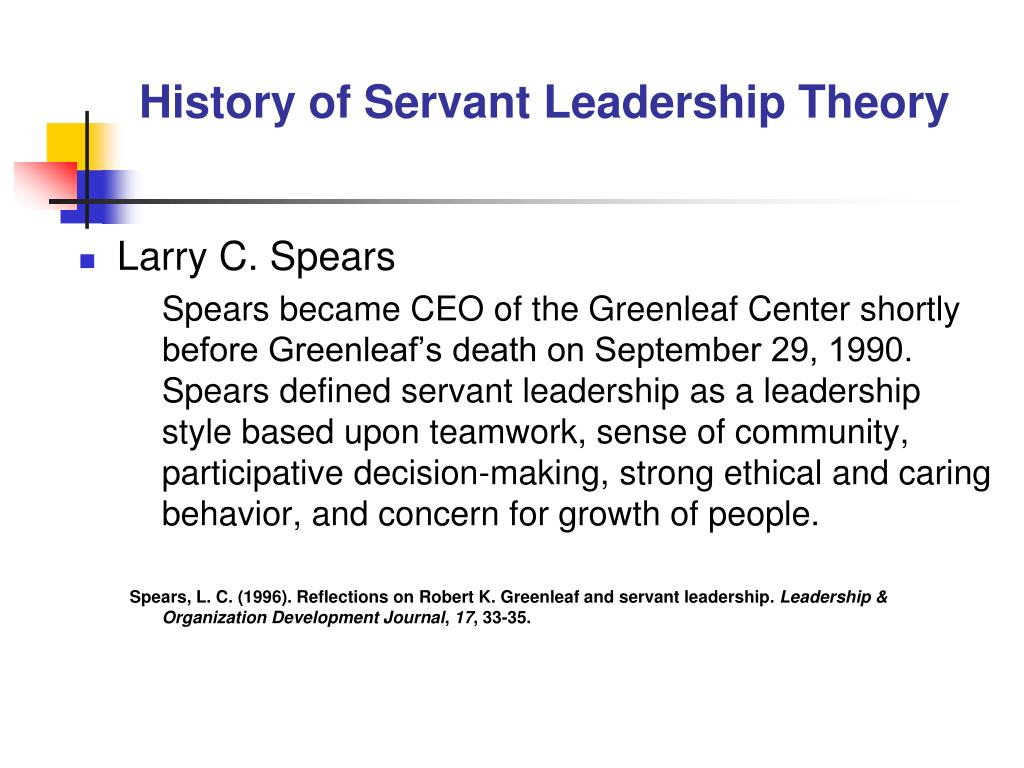
Patterson’s new theory of servant leadership. Servant leadership can improve an organization and/or society over the long term. To help create a platform for more specific research on servant leadership, patterson (2003) developed a working theory of servant leadership comprising of.
Despite being five decades old, “servant leadership” is a philosophy that is still earning quite a bit of buzz—because it’s so effective. Social learning and social exchange theory. One stream has focused on the clarification of the construct and the servant leadership theories in organizations, including scale development and validation.
In servant leadership literature, the use of social learning theory argues that servant leaders are influencing their followers, as their followers observe and emulate the leader's positive. The theory of servant leadership was started by robert k. In 1970, greenleaf used his experience as the director of management development at at&t to publish an essay titled “the servant as a leader.”
However, its effectiveness in organizations is still being debated. However, the model is not limited to the christian realm. What is servant leadership theory?
While traditional leadership generally involves the accumulation and exercise of power by one at the “top of the pyramid,” servant leadership is different. Servant leadership is based on the idea that authority is more important than power, and that focus on empowering and uplifting others instead of personal gain is. A second stream has been investigating the mediating and moderating mechanisms through which servant leadership leads to a series of behavioral, attitudinal and performance outcomes, both.
Devellis’ (1991) guidelines for scale. Numerous research studies have focused on such relationships between theories. Greenleaf, who popularized the term in a 1970s essay titled the servant as leader.
Understanding the pros and cons of any philosophy is crucial to any leadership style you adopt. Leading as a servant comes with certain advantages and some downsides. Servant leadership is often associated with christian leadership and christian leaders;
To summarize, the leader puts the needs and wants of the subordinates first by helping them to develop professionally. The servant leadership style has been developed over the ages to create sympathetic and highly motivated leaders with a humble leadership style. Many researchers and theorists argue that servant leaders can become so focused on the needs of.
The meaning of servant leadership can be explained in different ways, but at the heart of the servant leadership theory is the principle that the leader is a servant first. Effective servant leaders are aware of themselves and their teams. Servant leadership promotes and emphasizes on the need for the leader of a group to put the needs of others before his own, and to motivate others to develop and perform in the best way possible.
There is no perfect leadership theory or technique. The definition of servant leadership as defined by its creator, robert greenleaf, is that the focus of leaders is on others rather than upon self and on understanding the role of the leader as a servant. Servant leadership predominately draws on two social theories to explain how it influences follower behavior:
Servant leadership is one of the more popular theories of leadership, especially among christian leaders who vigorously cite jesus as the penultimate example of servant leadership. This effort may come at the expense of the servant leaders own wellbeing. (russel and mcminn, 2001) this truly sounds like an ideal leadership theory, assuming all of the factors stated above remain true, and are.
Though he was aware of the negative connotation. (1) deter mine clearly what it. The servant leadership theory is focused on the idea that at the top of the hierarchy or system are the employees, and that a manager or leader’s top priority is to serve them.
Interesting to consider servant leadership in comparison with other, more established, leadership models. Greenleaf’s theory argues that the best leaders are those who are the ‘servants’ of the people.

Pin by The Art Of Gandy on Servant Leadership Principles in Action

10 Principles Of Servant Leadership JONATHAN SANDLING
PPT Seven Factors of Servant Leadership PowerPoint Presentation, free
PPT Celebrating Servant Leaders in the Classroom PowerPoint

The 6 main principles of servant leadership Deepstash